The convention season is here, and whether this is your first con or your fifteenth, a little intentionality goes a long way toward making it great. The difference between a good weekend and an incredible one often comes down to a few small choices like who you talk to, what you sign up for, and when you give yourself permission to change course.
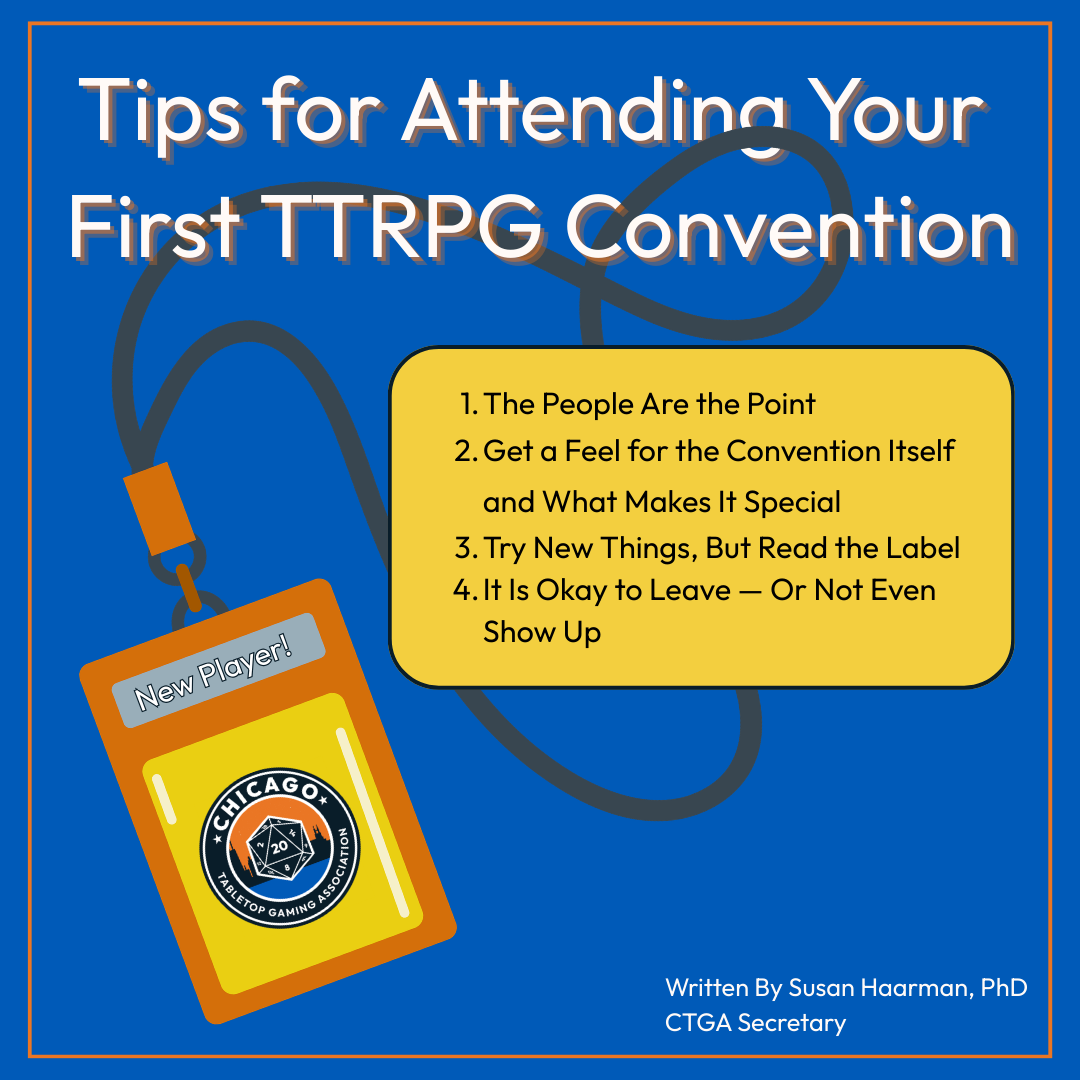
Here are four things worth keeping in mind.
1. The People Are the Point
It is easy to treat a convention like a schedule to optimize — fill every slot, play every system, collect every freebie. It’s my default setting, so believe me, I get it! But the most valuable thing you will leave with is not a tote bag full of zines. It is the people you met.
TTRPG conventions are surprisingly small worlds, especially because most of the time, you’re going to ones near you, and if you like it, you end up going back. The GM running your Saturday morning one-shot? You might end up at their table again at the next event, or find out you live three neighborhoods apart. The player who made that perfect character choice in the first session might become someone you look forward to seeing every year, even if you live in completely different states and only overlap at events.
After a few cons, you start to develop a roster of GMs whose tables you will always try to get into, players you hope to run into, and names you recognize on the schedule and immediately book. I’ve only been going to a smaller circuit of conventions for 3 years now, but I’ve somehow managed to build a little group of folks I’m excited to see every time. I always sign up for Scott McKinley’s games. I know Kyle and Rebecca McCordic are always a delight to have at my table. You’ll be surprised by the way these con relationships grow!
This is one of the things that makes the regional convention scene genuinely special. It’s not a one-time gathering of strangers. It’s a community that reassembles itself, in different configurations, across different cities, across years. People keep track of each other. They save seats. They recommend each other's games. They remember the bit your character did two years ago at a con in another state and bring it up like old friends do.
So introduce yourself. Ask what else someone is playing this weekend. Exchange contact info, even if it feels awkward. The con is a concentrated version of what the hobby is actually about: showing up, being present, and making something together with people you did not know before. Let it do that work — and then keep showing up, because the network you build one handshake at a time is one of the best things this hobby has to offer.
And if it turns out they're from the Chicagoland area, tell them about CTGA. We're always happy to have more people at the table.
2. Get a Feel for the Convention Itself and What Makes It Special
Not all conventions are built the same. Some are sprawling, multi-track events with programming for every taste (GenCon). Others are intimate and community-focused, where half the attendees seem to have known each other for decades (GaryCon). Some skew toward indie and story games; others are D&D and OSR wall to wall.
Spend a little time getting oriented with the offering on the con web page and again when you get there. Walk the floor. Notice who’s got a concentration of game. Think about making game choices based on what fun flavor of games a con uniquely offers. When I’m at Gamehole (my favorite con), I know Monte Cooke and You Too Can Cthulu will be there in force, so I get excited for Cypher system and horror games.
Big cons like GenCon or DragonCon sometimes offer really unique multitable events because the people and the infrastructure and scale are hard to replicate at smaller cons. Maybe this is the year you do the Living Vaesen campaign at Gamehole because you know it’s not happening anywhere else. Context helps you make better choices about where to put your limited time and energy. Is this a unique opportunity you might only get at this con?
3. Try New Things, But Read the Label
One of the genuine gifts of a convention is access to game setups you simply cannot replicate at home. If your regular table is all theater of the mind, this might be the weekend to sign up for that miniature and terrain-heavy D&D game with the GM who builds custom dungeon tiles. If you've never played a narrative game with no dice at all, a convention one-shot is a low-stakes place to find out if that's for you. The limited commitment of a con game makes it the perfect laboratory for expanding your palette.
Every convention game comes with a description, and those descriptions are doing a lot of work. They tell you the system, the tone, the content, and often the GM's style. Skipping them is how you end up in an intense, grimdark horror scenario when you were expecting a light heist comedy.
This matters even more when you are trying something new. If you have never played a particular system or genre before, the description is your best preview. Does it mention collaborative, character-focused play? That is probably going to look different from a dungeon crawl with tactical combat. Neither is wrong, but knowing which you are signing up for shapes how much fun you will have. When in doubt, Google a game system and do a little reading or even message the GM ahead of time.
I'll share a real example of why this matters. I once ran a session of Eldritch Automata — a great atmospheric and dark game where themes of trauma, stress, and sanity are woven into the mechanics and the fiction in ways that are intentional and not incidental, but also very responsibly. A player sat down and then flagged, once we were already at the table, that any discussion of mental illness was a hard line for them. That's a completely legitimate boundary.
But it was also baked into the mechanical rules of the game in ways that made the session genuinely difficult to navigate for everyone. It might have been avoided entirely if they had read the description before signing up. Reading the label protects you and queues the GM up for success.
4. It Is Okay to Leave — Or Not Even Show Up
Here’s my hot take!
Con time is precious and finite, and most people overbook themselves. That is just the nature of looking at a full schedule and wanting all of it. But by Saturday afternoon, exhaustion is real. If you signed up for a 9pm game and you are running on empty, dropping it is not the worst thing you can do. The worst thing is ghosting.
Let the GM know you are not coming via a quick message on the con site, so they aren’t waiting on you before they start. GMs often overbook a table to max hours for badges, and I know I’ve been delighted to find out I was running a 5 rather than a 7-person game because of drops. And honestly, a smaller table that is fully present often makes for a better game than a full table with one person who is half asleep and counting the minutes. You are doing everyone a favor by being honest about where you are at.
The same goes for leaving a game mid-session. This one might feel a little uncomfortable to think about doing, but not staying at a table you don’t want to be at is the biggest con gift you can give yourself.
Sometimes a table is actively not okay or toxic. If a player is making the experience genuinely uncomfortable for you, or you ask folks to respect a boundary you have and no one listens, get up. Something is happening that you did not sign up for and do not want to be part of. In those cases, leave without feeling guilt or feeling obligated to give a long explanation. A quiet word to the GM is still helpful (they may not know what is happening on their end of the table), but your safety and comfort come first. You do not owe that table anything.
Also, not every table is a good fit, and it does not have to be dramatic to justify stepping out. Sometimes the tone is off. Sometimes you just realize twenty minutes in that this is not how you want to spend the next two and a half hours, and that is a completely legitimate reason to leave. You do not have to wait for something to go wrong. If you are not having fun, that is enough. Wish folks a good con, but let them know your plans shifted/have to get dinner/your friend Susan needs you to pick her up.
The hobby is too good to spend it at the wrong table.
Don’t forget: Have fun!
Conventions are a LOT. They are also genuinely wonderful. The best ones leave you exhausted in a good way and full of new games, new people, and at least one story you will be telling at tables for years. So do your homework, introduce yourself to strangers, read the game descriptions, and get some sleep. The dice will still be there in the morning.
See you out there. And if you spot someone from CTGA, say hi!
This article was written by Susan Haarman, PhD, a board member of the Chicago Tabletop Gaming Association. If you’d like to get more involved with the tabletop community in Chicago, join us at one our upcoming events or on Discord to be apart of discussions like this one.

Disclaimer: The information in this blog and on www.chicagotga.org is presented for educational and entertainment purposes. Any statistics, recommended products, or other information is researched in good faith, but no warranty is made to the completeness nor accuracy of the source. All written and multimedia content published here is the intellectual property of Chicago Tabletop Gaming Association (CTGA) or contributing community members and is not for reproduction or sale by third parties. By accessing this site and all its materials, you agree to and acknowledge these terms.