Ranking the D&D Classes from Straightest to Queerest: A Pride Tier List

A confession before we begin — I am not a neutral party to this ranking, and you should not trust me. You should, however, keep reading.
–Written By Susan Haarman, PhD, Unrealiable Narrator
A second confession: every class can be played by every person, and every class can be played gay. The most achingly tender lesbian arc I have ever witnessed at a table was between two human Fighters played by very burly straight men at a con who refused to use a single feeling-word in each other's direction, except to praise each other's violent handiwork. Identity is a rich tapestry. The dice do not care.
But also, come on. We all know. Let us proceed.
#12. Fighter
I am sorry to the Fighter. Someone had to be last.
The Fighter is not homophobic. The Fighter has simply, in fifteen levels of adventuring, never had an unprompted thought about his own interiority. The Fighter went to the weapons store, picked up a longsword, and has been swinging it the same way since. His backstory is "I was a soldier." His character growth, by level eleven, is "now I have two longswords."
This is not a tragedy. This is a specific way to move through a fantasy world, and it deserves respect. It just also happens to be very, very straight.
(I will allow that the Eldritch Knight has read one book and is, on that basis alone, complicated.)
#11. Ranger
The Ranger is bisexual, but the word for it has not reached her yet.
She has an animal companion she calls "my best friend." She spent three years in the wilderness with another Ranger, and they did not kiss. She owns one flannel. She is going to work it out around level fourteen, and we are all going to be very supportive about it then. There is a quiet honor in playing the Ranger who has not yet had the conversation with herself. A lot of us were that Ranger once.
#10. Paladin
I anticipate complaints. But the base-model Paladin (e..g., Oath of Devotion, sword and board, "for honor and glory") is a gal so committed to performing virtue that she has not noticed she is in love with the Fighter. She will not notice. She will marry a prince, write the Fighter a letter every week for forty years, and die believing they were merely very close friends with a robust correspondence.
It is the most heartbreaking gay love story ever told, and from the outside, it looks like nothing happened at all. There is something almost Victorian about it. There is something almost worth running a one-shot about.
Addendum: Oathbreaker Paladins are gay because Oathbreaker Paladins have thoughts. And those thoughts launched a thousand A03 ships.
#9. Monk
The Monk is in a complicated relationship with their own body, and monks either have taken a vow of celibacy or are the single horniest character at the table, and there is no in-between. But I do not think the Monk is queer in the orientation direction. I think the Monk is queer in the gender direction, and I think they have transcended the discussion. The Monk's pronouns are whatever the Monk requires them to be on a given day.
The Monk has done The Work, so the Monk is doing handstands now. We should leave them be.
#8. Cleric
The Cleric is, almost without exception, working something out.
I do not mean this dismissively. I mean it as a licensed therapist who has watched a great many people roll up a Cleric for what they swore were purely mechanical reasons, and then play eighteen sessions of a character whose entire arc was about the slow, painful renegotiation of their relationship to a higher power. The Cleric does not pick up a holy symbol because they want a free cantrip. The Cleric picks up a holy symbol because there is something unresolved between them and the divine, and they have decided, brave or foolish or both, to keep showing up to the conversation.
The Cleric is the player who was raised in the faith and left, or who was raised in the faith and stayed in a way that has cost them, and who is now, at twenty-eight, sitting at a folding table in Logan Square, rolling up a Light Domain priestess whose god is almost the one she grew up with, but not quite.
This is not a problem unique to queer people. But queer people, in my professional and personal experience, get there earlier and have to work harder. A lot of us spent our formative years being told the divine had an opinion about us, specifically, and we have spent the years since figuring out what to do with that information. The Cleric is the class where you can play a person who still believes, just differently.
#7. Druid
The Druid is pansexual. The Druid has also been polyamorous since before polyamory had a name, and was in fact, doing it before language was. The Druid's ideal Saturday is foraging with three different partners and refusing to clarify the relationship structure to any of them. The Druid uses they for the bear they sometimes are, for themselves, for most NPCs they meet, and for the soup.
If you have ever played a Circle of the Moon Druid who got a little too invested in being the bear, you understand what I am saying, and I will not make you say it aloud in front of the whole table.
#6. Rogue
The Rogue is that one bisexual at the party that you can tell, on sight, is going to be the subject of your group chat for the next six months, and you are going to thank them for the inconvenience.
They have a "complicated history" with the Bard. They have a "complicated history" with the Bard's ex. Their backstory contains, at minimum, two ex-lovers, one of whom was a noble, one of whom was a thief, and at least one of whom may have been the same person under two different names.
The Rogue is not higher on this list only because the Rogue would, on principle, refuse to be labeled. Labels are a kind of trap, and they pick locks for a living.
#5. Barbarian
The Barbarian is so far past the closet that the closet is in a different time zone. The Barbarian was, depending on the backstory, raised by three mothers, or by an entire all-women raiding party, or by wolves. None of these produce a heterosexual.
I think what makes the Barbarian queer is the rage mechanic, honestly. Rage, mechanically, is what happens when you stop suppressing something. Butch Barbarian is the patron saint of every player who has ever picked up an axe in anger. Himbo Barbarian is so kind to every man he meets that I do not have the heart to tell him what he is. We love them both.
#4. Sorcerer
The Sorcerer is queer because the Sorcerer is. The magic was not chosen. The magic is simply in there. The whole class identity is "I was born this way, deal with it," which is a thesis statement that Lady Gaga has been gently preparing the wider culture for since 2011.
#3. Wizard
You thought Wizard would be lower, did you not? You saw "old man in a tower", and you mentally filed him next to Fighter. Well, stop being distracted by the Dancing Lights and start paying attention.
The Wizard went to school. The Wizard had a roommate. The Wizard and the roommate were "very close." The Wizard's familiar is named after the roommate. The roommate died sixty years ago, and the Wizard is currently researching necromancy "for purely academic reasons." The Wizard has never married. The Wizard's tower has one bed.
Above the fireplace is a portrait. The Wizard does not discuss the portrait.
#2. Warlock
The Warlock signed a contract with an otherworldly being in exchange for power, and you are going to tell me that is not a metaphor? "I made a deal with an ancient entity who whispers to me in my sleep, and now I have abilities my family does not understand" is not a heterosexual sentence.
Warlocks invented yearning. The entire pact-magic system, mechanically, is a metaphor for a relationship in which one person is doing significantly more work than the other and is choosing, against all reason, to call that a love story. Every "I would burn the world for you" monologue at every table in the world began as a Warlock soliloquy, delivered to a patron who is, candidly, not even returning the texts.
#1. Bard, but not for the reasons you think
Here is where I am going to lose some of you, but stay with me.
The seducing Bard is, in fact, straight in the way that any cliché is straight, which is to say, by default. The Bard who walks into the tavern, rolls Performance, and sleeps with the barmaid is not doing anything queer. They are doing a bit, and the bit is old, and old bits are how the dominant culture moves through a fantasy world without thinking about it. Seduction-as-class-feature is the Fighter's longsword in a frilly shirt.
The queer Bards (and they are the real ones, the ones who actually deserve the top spot) are doing something else entirely.
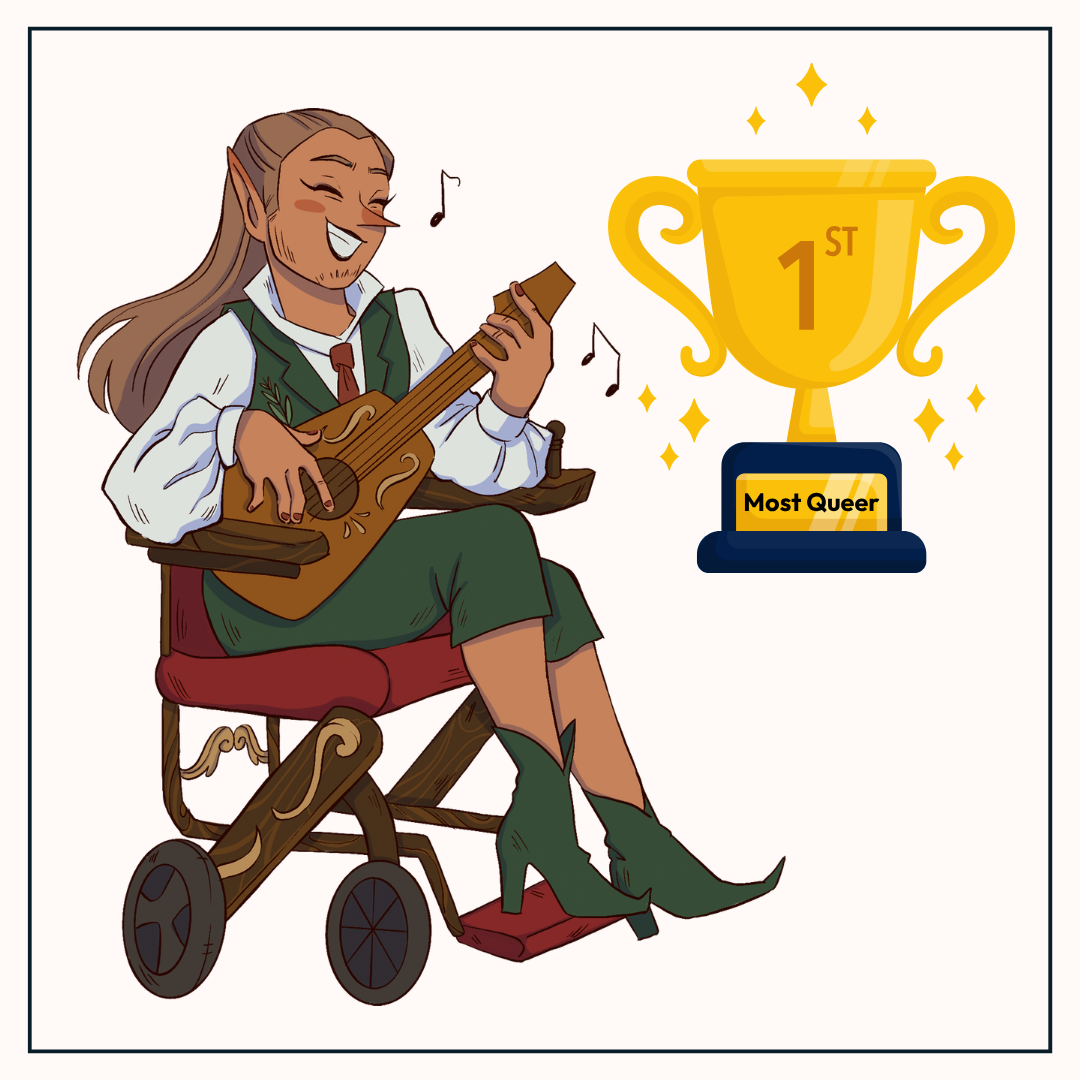
The queer Bard is the slightly anxious 5'4" historian who took College of Lore because he wanted to know things, and who is genuinely surprised when the party expects him to flirt with the duke.
The queer Bard is the College of Spirits player who has been talking to her dead grandmother all session and is not going to stop to make a Persuasion check on you.
The queer Bard is the one whose instrument is a hurdy-gurdy, and who will explain to you, unprompted, what a hurdy-gurdy is.
The queer Bard is unsexy on purpose, because being a person is more interesting than being a fantasy. The queer Bard knows that the most charismatic move at any table is to commit, fully, to a character who is not trying to be charming. The queer Bard reads the room and then chooses, deliberately, to be the wrong thing for it.
This is, I think, the actual queer move at a tabletop game, and the reason Bard ends up on top of this list despite the seducing-Bard discourse. Queerness, is not really about who you are flirting with. It is about a sustained willingness to be a specific, particular, slightly off-format person at a table that expects something more legible. The queer Bard is whoever shows up and refuses to be the bit.
Want to join the party?
Have some thoughts about where your favorite class landed on the list? Or maybe a nomination for Artificer’s ranking? (They’re obviously extremely queer and ace, but I’m open to debate.) Come join our Discord server! It’s a great way to get to know LGBTQIA+ community members who love TTRPGs as much as you do.
The Chicago Tabletop Gaming Association is dedicated to making Chicago the center of the TTRPG multiverse. And the only way to do that is to make sure everyone is at the table. We strive to keep this community a safe space for those of all genders and sexualities. After all, we’re all here to explore.

Disclaimer: The information in this blog and on www.chicagotga.org is presented for educational and entertainment purposes. Any statistics, recommended products, or other information is researched in good faith, but no warranty is made to the completeness nor accuracy of the source. All written and multimedia content published here is the intellectual property of Chicago Tabletop Gaming Association (CTGA) or contributing community members and is not for reproduction or sale by third parties. By accessing this site and all its materials, you agree to and acknowledge these terms.