3 Holiday Animals That Deserve to Be Your Next Boss Fight
Every December, a GM somewhere decides the holiday one-shot needs a big bad, and it usually ends up being an evil snowman or Krampus. Look, I love Krampus (I wrote about him last year), but he could use a night off. Nature has already done plenty of monster design for us, and a surprising amount of it shows up on holiday tables, in carols, and on greeting cards looking perfectly harmless.
Here are three real animals with holiday credentials who would make better boss fights than whatever you were planning to homebrew.
1. The Wild Turkey
We treat the turkey as a soft, round centerpiece, but the wild version is a much more serious opponent. Wild turkeys can run about 25 miles per hour and fly around 55 in short bursts. They also sleep in trees, so the bird you assumed was stuck on the ground has had the high ground all along. Their bare heads can change color in seconds when they get excited, which is about as clear a warning of an incoming attack as any boss has ever given.
They will also come for you. Massachusetts wildlife officials have explained that turkeys live by a pecking order and may try to dominate or attack people they see as subordinates. In other words, the turkey has sized you up and decided where you rank (1).
(1.) I would like to know where I rank. I would also like to never find out.
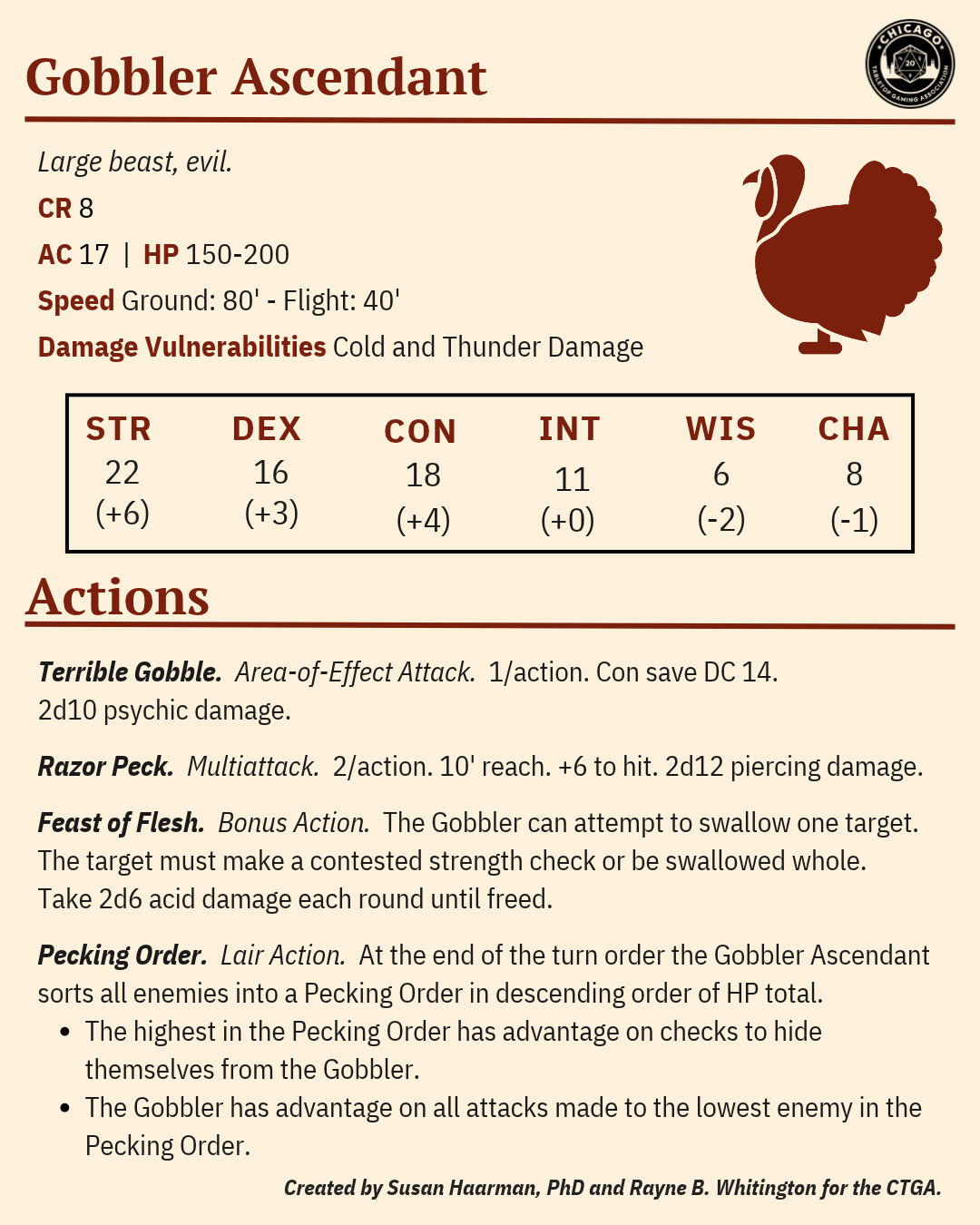
At the table: Make the Gobbler Ascendant a two-phase fight. In the first phase, it runs faster than anyone in the party; in the second, it attacks from the branches. A lair action could sort the party into a pecking order each round, with the lowest-ranked character drawing its attention.
Officials recommend loud noise or a spray of water to scare off a bold turkey, so reward the bard who thinks to yell and the druid who makes it rain.
2. The Christmas Goose
Geese don't have true teeth, but their bills have teeth-like serrations, and so do their tongues. If a goose has ever lowered its head at you in a Chicago park in spring, you already know it doesn't need a backstory to be frightening.
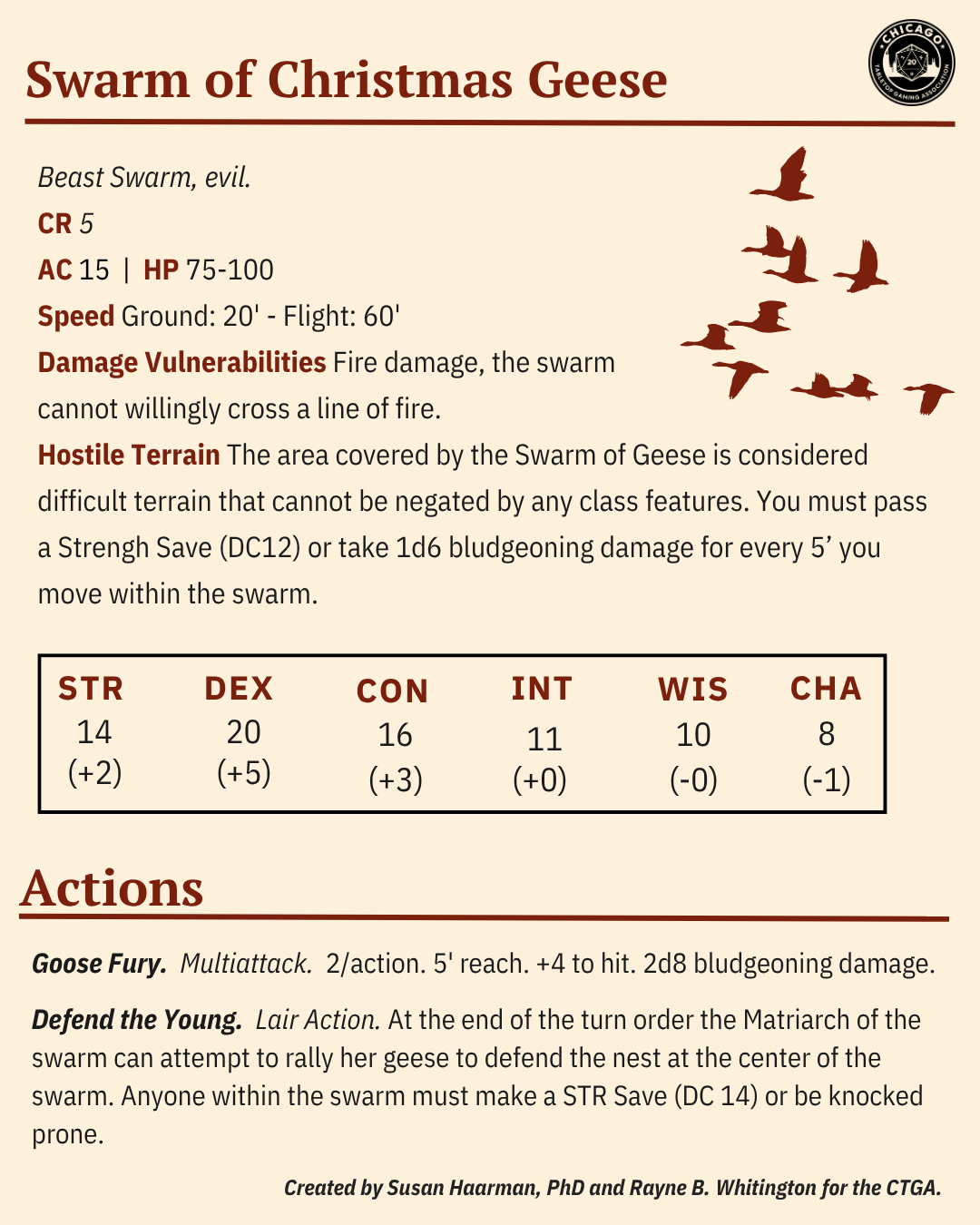
At the table: Run a flock as a swarm with one loud matriarch at the center. Make the objective getting past the nest rather than winning the fight, since geese protecting their young are the angriest geese of all.
3. Santa's Reindeer
Male reindeer shed their antlers between late November and mid-December, while females keep theirs until they give birth in spring. Any reindeer pulling a sleigh with full antlers on Christmas Eve is probably female, so the team has been doing the work while a man in a red suit takes the credit, and are therefore chock full of righteous rage (2).
(2). This is the holiday special I would actually watch.
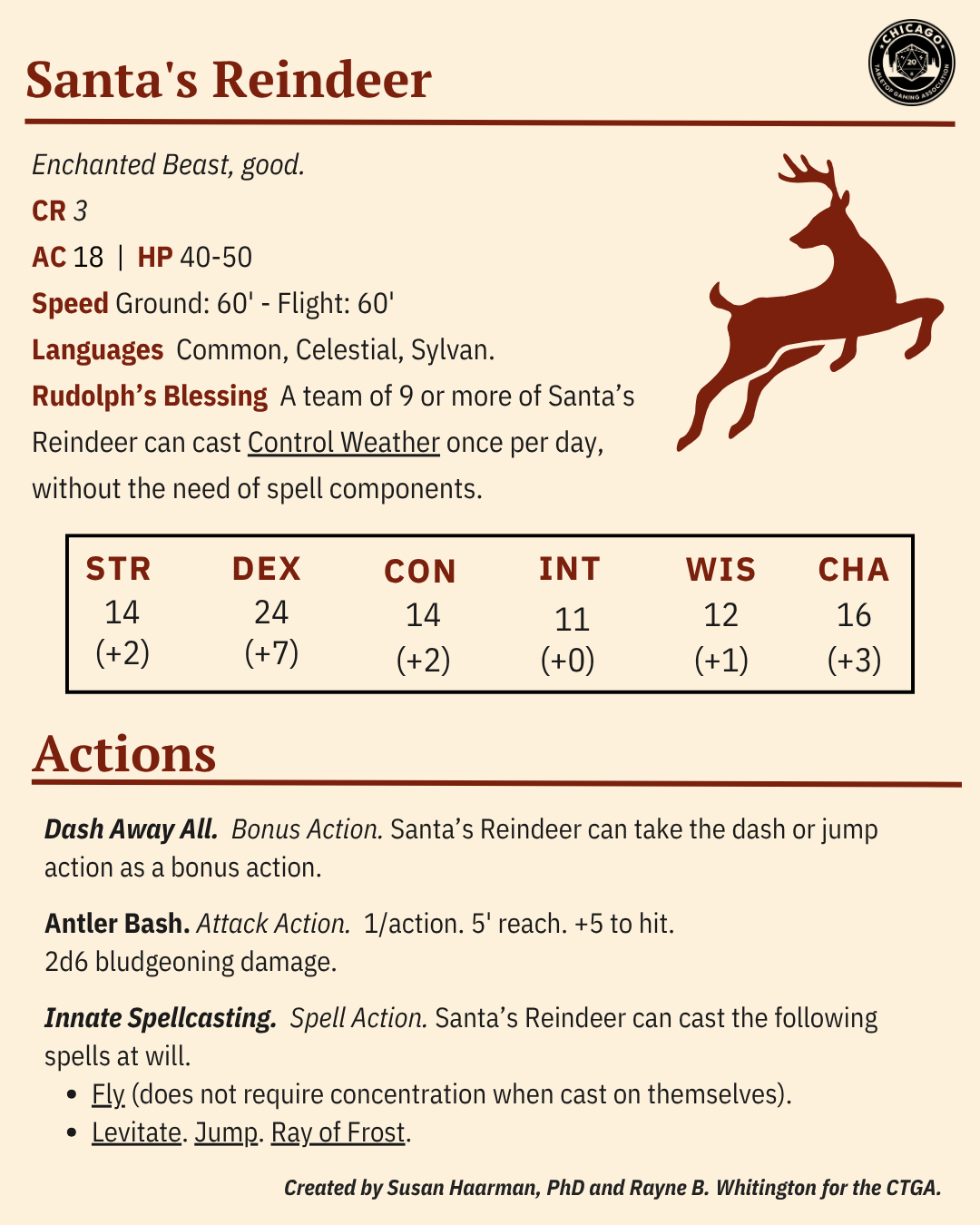
At the table: The Matriarchs of the Sleigh can be an encounter and a labor dispute at once. They have flown this route for centuries without a raise, and a party willing to negotiate on their behalf might gain eight very strong, very well-informed allies.
Bring the Bird to the Table
The best holiday monsters are the ones hiding in plain sight, so this year skip the evil snowman. Look at what's on your plate, in your carols, or honking at you in the park, and ask what it would do with a stat block. Then please send me the stat block.
This article was written by CTGA Secretary, Susan Haarman, PhD. When she’s not busy giving back to the community, Susan runs imaginative games of D&D, Fatherfog, and lots of other TTRPGs full of strange and wonderful monsters like these. The stat blocks for these monsters were created by Rayne B. Whitington, CTGA Board Member. Rayne also runs TTRPG games around Chicago.
Want to share your favorite homebrewed holiday monstrosity? We’d love to see it in the Discord! Use the button below to join our server and check out the “game-dev-discussion” or the “gm-discussion” channels.

The information in this blog and on www.chicagotga.org is presented for educational and entertainment purposes. Any statistics, recommended products, or other information is researched in good faith, but no warranty is made to the completeness nor accuracy of the source. All written and multimedia content published here is the intellectual property of Chicago Tabletop Gaming Association (CTGA) or contributing community members and is not for reproduction or sale by third parties. By accessing this site and all its materials, you agree to and acknowledge these terms.